Tattoo
The insertion of pigment into human skin tissue by piercing the skin with a needle.
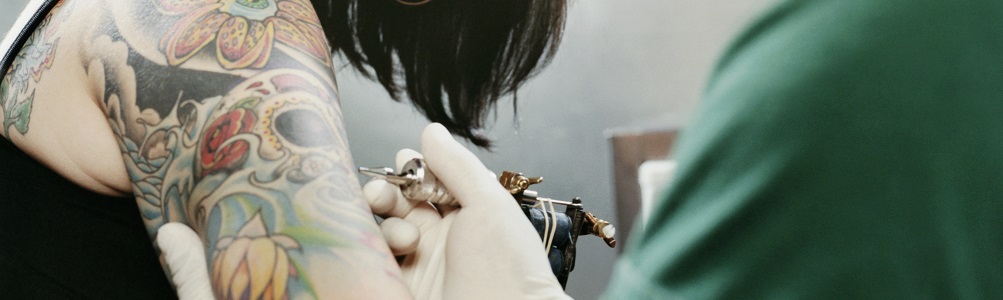
Body art, including tattooing, body piercing, and branding, has been practiced for centuries across many cultures. Today, the industry also includes permanent cosmetic procedures such as microblading and micropigmentation.
During these procedures, a licensed body art practitioner uses specialized equipment—including needles, pigments, and other instruments—to alter the skin. For example, tattoo and permanent makeup artists commonly use an electric handheld machine to implant pigment into the outer layers of the skin. While some procedures may be reversible, many body art services produce permanent results.
To help protect the health and safety of both practitioners and clients, every body art practitioner operating in Los Angeles County must be registered with the Los Angeles County Department of Public Health, Environmental Health Division.
Information about registration requirements, permits, and the Body Art Practitioner Registration Process is available in the sections below.
Understanding the different types of body art can help practitioners, business owners, and clients determine which activities are regulated under California's Safe Body Art Act. The following definitions provide an overview of the most common body art procedures.
The insertion of pigment into human skin tissue by piercing the skin with a needle.
The creation of an opening in the body for inserting jewelry or decoration. Ear piercing (excluding the tragus) with single use, pre sterilized equipment is not classified as body piercing.
The application of pigments into human skin tissue to permanently change the color or appearance of the skin. This includes microblading, micropigmentation, lip liner tattoos, and similar cosmetic procedures.
The process of burning a mark or marks into human skin tissue with a heated iron or other instrument with the intention of leaving a permanent scar.
View list of permitted body art practitioners in Los Angeles County.
Body art procedures can pose health risks to both practitioners and clients. The primary concerns include localized infections at the procedure site and the transmission of bloodborne diseases, including Hepatitis B and Hepatitis C.
To help reduce these risks, California has established regulations that promote safe body art practices, proper sterilization procedures, and infection prevention. These standards help protect practitioners, clients, and the public from cross-contamination and the spread of disease.
The Los Angeles County Department of Public Health, Environmental Health Division registers body art practitioners and permits body art facilities to help ensure compliance with the California Safe Body Art Act (opens in a new tab).
If you have a body art business located in Los Angeles County, you are required to obtain a Public Health Permit in order to operate the business.
Please Note: The cities of Long Beach (opens in a new tab), Pasadena (opens in a new tab), and Vernon (opens in a new tab) operate their own environmental health departments and should be contacted directly if your business is located within one of those cities.
All Body Art Practitioners must be over the age of 18, register with their local agency, and perform body art at a permitted facility. Registrations are only valid within Los Angeles County and may only be used outside of Los Angeles County as limited in California Health and Safety Code (opens in a new tab).
Submit your completed application packet, required documentation, and payment by mail.
Contact the Body Art Program to schedule an appointment.
Monday through Friday
8:00 a.m. – 3:30 p.m.
Find permit information, applications, checklists, and supporting documents for body art facilities, temporary events, mobile body art facilities, and bloodborne pathogens training providers.
All Body Art Facilities, such as tattoo parlors, piercing shops, permanent makeup businesses, and microblading businesses, must have a Public Health Permit.
Submit the following:
Submit the following:
Review the Body Art Facility Plan Check Guideline (opens in a new tab) before submitting your application.
A Public Health Permit is required to operate a Body Art Temporary Event and each participating Temporary Body Art Facility. In addition, each participating Body Art Practitioner is required to be registered.
For your convenience, we have prepared our Temporary Body Art Facility Requirements Checklist (opens in a new tab) to help you meet the requirements.
To host and/or participate in a Body Art Temporary Event, review and submit the following:
Please visit our Body Art Events Frequently Asked Question page.
A Public Health Permit is required to operate a mobile body art facility. Please contact the Body Art Program at (626) 430-5570 or bodyartprogram@ph.lacounty.gov for more information.
If you are interested in becoming an approved bloodborne pathogens exposure control course provider for the County of Los Angeles, refer to the training provider course requirements (opens in a new tab), then complete and submit the following:
Bloodborne Pathogens Exposure Control Training Providers need to renew their training certification every 3 years. If you are already a course provider for the County of Los Angeles and need to update business, owner, billing/mailing, or training website information, complete and submit the Bloodborne Pathogen Exposure Control Training Provider Update Form (opens in a new tab).
Problems at body art facilities can be reported by calling Public Health at (888) 700-9995 or by using the Environmental Health Online Complaint System.
Public Health will not ask about your immigration status, and you may file a report without giving your name.