




Introduction
Page Updated 7-13-2026
- This webpage provides tools and tips to help you navigate information, build confidence, and make informed decisions about vaccines.
- Staying informed with accurate health information helps protect you, your family, and your community from vaccine-preventable diseases.
- Trustworthy information can help you feel more confident in your decisions about vaccines.
- Sharing reliable health information with others can help them build confidence in vaccines and supports healthier communities.
Your questions are important to us. Click here to submit vaccine related questions, concerns, or information you'd like clarified and a member of the Vaccine Preventable Disease Control Program will address them.
Information for the Public
How Vaccines Work
Vaccines are a safe and effective way to protect you and your loved ones from serious, preventable diseases. By following the recommended vaccination schedule, you ensure that you receive protection at the right time, based on your age and health status, before being exposed to harmful infections.
How Vaccines Work
- Vaccines work by mimicking a virus or bacteria and teach the immune system to recognize the infection and fight the germ.
- This teaches the body how to protect itself from a disease without experiencing an infection or severe disease.
- To learn more about how vaccines work, view the educational videos from trusted resources below.
How do vaccines work? This video explains how vaccines protect children from dangerous diseases and covers topics such as vaccine ingredients, side effects, and their safety. |
|---|
How do vaccines work? This video explains that vaccines help your immune system prepare for infections by providing it with the information needed to fight back more effectively. |
|---|
A Vaccine's Journey Through the Body This video explains how vaccines inform the immune system how to fight infections, and how the vaccine components are removed from the body. |
|---|
How do we know vaccines are safe? This video explains how vaccines are tested compared to other medicines and vitamins, and how safety systems in the U.S. keep an eye on vaccines to quickly catch any problems. |
|---|
Vaccine Safety
Before a vaccine is recommended for use, it goes through a strict process to help ensure it is safe. That process includes:
- Research & Testing.
- Vaccines go through multiple phases of clinical trials with thousands of volunteers.
- Expert Review.
- After testing, the vaccine is reviewed by the FDA, along with public health experts, before it is approved and recommended for use.
- Continuous Monitoring.
- After approval, vaccines are closely monitored by vaccine safety systems to make sure they remain safe.
Visit the Voices for Vaccines webpage about vaccine development and safety to learn more.
Tips for Finding Reliable Health Information
Finding Reliable Health Information Online
Most people look online for health information. About 7 in 10 U.S. adults use social media, and nearly 6 in 10 search the internet for health topics. With so much information out there, here are a few ways to check if the information is reliable:
- Check the source.
- Check to see who created the information.
- For public health information, use reliable sources like the California Department of Public Health or Los Angeles County Department of Public Health.
- Verify social media accounts are official (check their main website for links).
- Look for expertise.

- Make sure the information comes from trained health professionals with verified credentials (e.g., MD, DO, NP, PhD, RN, etc.) or trusted organizations.
- Verify accuracy.
- Compare the information with other trusted sources to see if the information matches.
- Check for updates.
- o Health information can change as more scientific evidence is gathered, so look for the most recent updates. To learn more, see the article How Research Works.
- Use fact-checking tools.
- Many websites and social media platforms often offer tools to help fact check or verify information.
- Talk to professionals.
- If something is unclear, ask your doctor or another trusted healthcare professional.
Additional Resources:
- Evaluating Consumer Health Websites (Johns Hopkins Medicine)
- Evaluating Internet Health Information (National Library of Medicine)
- Finding and Evaluating Online Resources for Health Information (National Center for Complementary and Integrative Medicine)
Tips for Navigating Vaccine Research Online

- Vaccine information online isn’t always consistent. Sometimes the information is outdated, incomplete, or misleading.
- Medical experts use years of training and careful, peer-reviewed research to help provide accurate and trustworthy information.
- To find reliable information about vaccines:
- Look for sources that use scientific evidence and include qualified experts.
- Check back as information may be updated as new research becomes available.
- Researching vaccines on your own can be tricky because:
- Misinformation online is widespread.
- Information online can vary in quality.
- Search engines can sometimes show sources that are not always reliable.
- It’s easy to focus only on information that matches what you already believe, even if other evidence says something different. This is called confirmation bias.
Understanding Health Information in the Media

- Sometimes different claims are presented side by side, even when they are not equally supported by evidence. This is called false balance.
- Look for which claims are supported by scientific research and trusted health organizations.
- For more information on how false balance can affect how vaccine information is presented, see the Voices for Vaccines False Balance in the Media toolkit, which provides examples related to vaccine topics.
False Information
Types of False Information
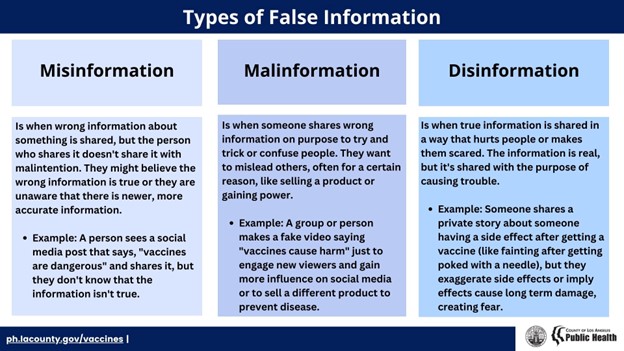
*Click the image to view.
Why is there so much Vaccine Disinformation?
Vaccine disinformation is very common but understanding some of the reasons why can help you recognize and counter false claims.
| Reason for Vaccine Disinformation | Explanation |
|---|---|
| Misinformation spreads faster than facts | False claims gain traction and sometimes boost engagement rates on people’s social media posts. |
| Mistrust in organizations | Past scandals and crimes can lead some people to distrust the organizations that committed them. |
| Political & Ideological influence | Vaccination is often politicized. |
| Profit-driven | Some individuals and organizations profit from anti-vaccine content through book sales, alternative treatment sales like “natural immunization” or supplements. |
| Biases & fear | People are naturally cautious about medical interventions and tend to believe information that aligns with their values and beliefs. |
| Medical errors | Rare but real medical errors are used to undermine trust in vaccines despite overwhelming evidence that vaccines are safe and effective. |
| Emotional & personal testimonies | Personal stories may be exaggerated or emotional, which can be persuasive. |
Myths & Misinformation
What are Myths and Misinformation?

- Myths are a widely held but false belief or idea.
- Misinformation is false or misleading information.
While myths and misinformation can be convincing, there are ways to evaluate the information you encounter.
Tips to bust myths and misinformation:
- Be Curious & Ask Questions. Consider who is sharing the information and why.
- Pause & Reflect. Does the information seem accurate? Is it consistent with other reliable sources?
- Check the Evidence. See whether the information is supported by facts from trusted sources.
Addressing Common Myths and Misinformation
- Myth: Vaccines cause autism.
- Fact: Extensive research shows no link between vaccines and autism or autistic disorders.
- A small study published in 1998 claimed a connection, but it had serious problems and false data. The study was later retracted, and its lead author lost their medical license. Since then, many well-designed studies have confirmed that vaccines do not cause autism.
To learn more, visit:
- Do Vaccines Cause Autism? - Video (American Academy of Pediatrics)
- Do Vaccines Cause Autism? (Autism Speaks)
- Myth: Vaccines contain dangerous & toxic ingredients.
- Fact: Vaccine ingredients are safe and used in very small amounts.
- Ingredients listed on vaccine labels may sound concerning (like mercury or aluminum), but the amounts used in vaccines are carefully studied and are not harmful. Many of the ingredients are found naturally in the body, food, and the environment.
To learn more, visit:
- Q&A Vaccine Ingredients: What You Should Know (Children's Hospital of Philadelphia)
- Q&A DNA, Fetal Cells & Vaccines: What you Should Know (Children's Hospital of Philadelphia)
- Myth: Vaccines have damaging and long-term side effects.
- Fact: Vaccines are not linked to damaging or long-term side effects.
- Vaccines are carefully tested for safety and monitored over time. Some people may have mild, short-term side effects to vaccination, such as pain at the injection site or low-grade fever. These side effects are not serious and typically go away quickly.
To learn more, visit:
- Do Vaccines Cause Long-Term Side Effects? (American Academy of Pediatrics)
Resources
- Vaccine Development & Safety (Voices for Vaccines)
- How Research Works (National Institutes of Health)
- Evaluating Consumer Health Websites (Johns Hopkins Medicine)
- Evaluating Internet Health Information (National Library of Medicine)
- Finding & Evaluating Online Resources (National Center for Complementary & Integrative Medicine)
- False Balance in the Media Toolkit (Voices for Vaccines)
- Types of False Information (PDF) (LAC DPH)
Immunization Schedules (CDPH recommends immunization of children, adolescents, and adults in accordance with the AAP & AAFP):
Information for Providers
Introduction
Vaccine confidence is the trust people have in vaccines, including their safety and effectiveness. Vaccine hesitancy is influenced by personal beliefs and social factors.
You are often the most trusted voice your patient hears on health decisions. When a patient has questions or concerns about vaccines, a clear, science-backed conversation can make a difference between hesitation and confidence.
Vaccine uptake is influenced by key decision points for individuals: awareness and risk of disease, and availability, accessibility, affordability, and acceptability of vaccines. By addressing these points, hesitancy can be better understood and solutions can be developed to address it.
Why Building Vaccine Confidence is Important
- When people hesitate about vaccines and refuse vaccination, it can lead to outbreaks of vaccine-preventable diseases and put vulnerable groups at risk for serious complications.
- Healthcare professionals play a key role in promoting vaccine confidence by offering clear and accurate information to help patients make informed decisions to protect themselves, their families, and their communities.
- Committing to communicating effectively about vaccines helps to achieve high vaccination rates, preventing individual and community-wide spread.
Strategies to Improve Vaccine Confidence & Reduce Hesitancy
- Improve vaccine confidence by:
- Providing clear and accurate information about vaccine safety and effectiveness. Education and reminders help increase vaccine use but may fail to address hesitancy.
- Reduce vaccine hesitancy by:
- Using a presumptive approach
- Using motivational interviewing, and
- Providing strong, clear recommendations
Understanding Parent Perspectives
Parents approach vaccines with different levels of confidence. Recognizing where someone is can help guide how you communicate.
Below are common vaccine archetypes and how they differ on the continuum of acceptance. Use this information to tailor vaccine confidence strategies with parents based on their archetype.
| Archetype | Description |
|---|---|
| Immunization Supporter | Parents who strongly believe in the importance of vaccines and always vaccinate their children. |
| Go Along to Get Along | Parents who don't question vaccines and generally vaccinate, but don't have in-depth knowledge about them. |
| Cautious Acceptor | Parents who have some concerns but still vaccinate their children. They may be hesitant but ultimately make the decision to vaccinate. |
| Fence-Sitter | Parents who aren't completely sure. They may be knowledgeable, but delay, refuse, or only partially vaccinate their child. |
| Refuser | Parents who refuse all vaccines for their child. Reasons may include distrust in the medical system, safety concerns, or personal/religious beliefs. |
(Adapted from Table 1 in AAP's "Strategies for Improving Vaccine Communication and Uptake")
Three Step Strategy to Building Vaccine Confidence
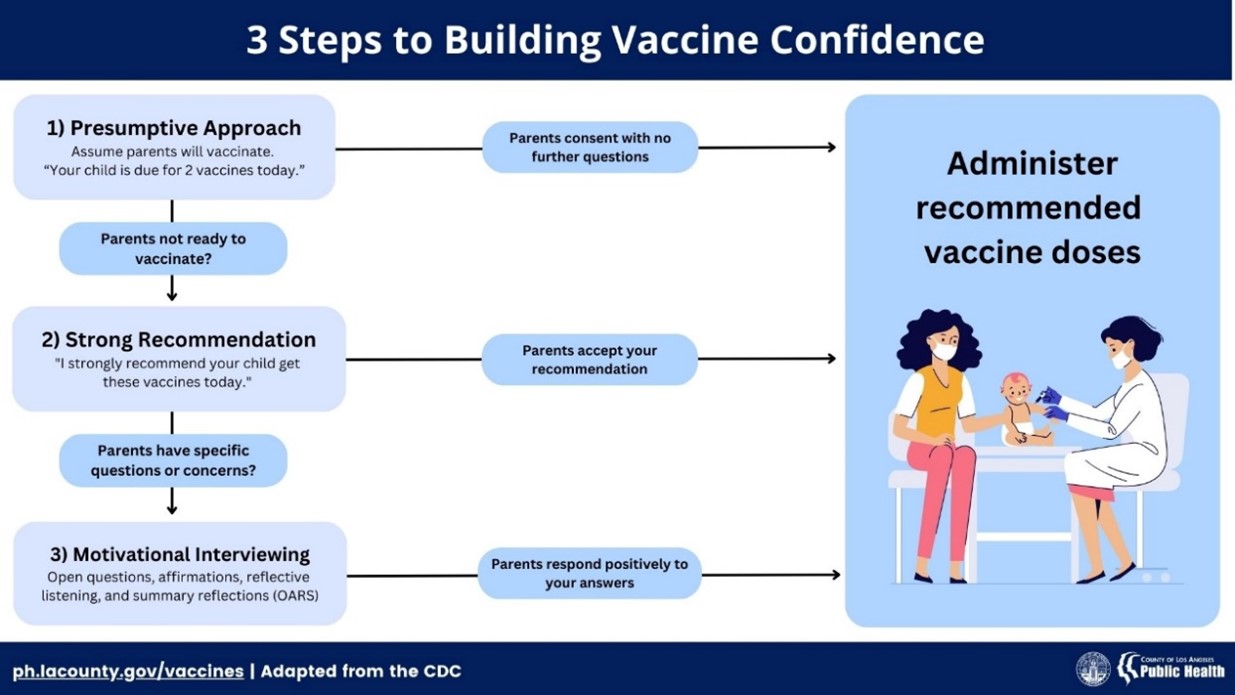
1. Presumptive Approach
Introduce vaccines with the assumption that your patient will choose to vaccinate.
Providers typically use two communication styles when discussing options with their patients: presumptive and participatory. Studies suggest that the presumptive method is more effective in increasing vaccination rates. The presumptive approach assumes readiness to vaccinate (e.g., "We’re going to..."), while the participatory approach invites discussion or seeks opinions (e.g., "Did you want to...?").
Presumptive Approach tips:
- Review and recommend any vaccines that are due at every visit.
- Be confident in your recommendations.
- Patients are more likely to accept vaccines when their healthcare providers believe in it.
- Instead of asking, “What do you think about getting [ ] vaccine today?” confidently say, “You are due for [ ] vaccine today.” Remember that tone and body language matter.
- Highlight the importance of vaccination for protection against serious diseases. Consider sharing your personal experiences with vaccination.
2. Strong Recommendation
Strong provider recommendations are an evidence-based strategy to increase vaccine acceptance in patients.
Children are more likely to receive vaccines when their parents receive a strong recommendation from a healthcare provider.
Strong Recommendation Examples:
- "I strongly recommend your child get these vaccines today."
- "These vaccines are very important to protect you from serious diseases."
- "I believe in vaccines so strongly that I vaccinate my own children according to the vaccine schedule."
- "This office has given thousands of doses of vaccines, and we have never seen a serious reaction."
Additional tools to support you in making a strong recommendation:
- EZIZ: Answers to Parents Top Questions (CDPH)
- Strategies for Improving Vaccine Communication and Uptake (AAP)
- Unity’s 3Cs free online course on communicating confident, concise, and consistent (3Cs) vaccination recommendations
3. Motivational Interviewing
If the patient or their parent is not receptive to your strong vaccine recommendation, use motivational interviewing to explore their questions, concerns, or hesitancy.
Motivational interviewing is a collaborative communication style that can help patients overcome reluctance and move toward behavior change. The physician’s role in motivational interviewing is to help address the patient’s concerns, not to solve the problem.
There are four key techniques ('OARS') in motivational interviewing.
- Open-ended questions.
Start by asking patients about their concerns and listen carefully to their responses. This helps build trust and shows that you respect their viewpoint.- Examples: “What’s your biggest concern about getting vaccinated?” -OR- “Tell me more about what you already know?”
- Affirmations.
Acknowledge the patient’s progress and show empathy during setbacks. Affirmations are more motivating than persuasion. Even if you disagree, expressing empathy can help build trust.- Examples: “I understand that you have concerns about vaccine safety and it is good to ask questions. I’m here to provide the information you need to help you make the best decision for your health.” -OR-"Ultimately, the choice is yours, and I’m here to provide any additional information you need to help you feel comfortable."
- Reflective listening.
Instead of giving advice, let patients share their concerns without interruption and then reflect the patient’s words back to them come up with solutions.- Examples: “You’re really worried and you want to make the best decision.” -OR- “You’re frightened by what you have read online.”
- Summarize.
Recap the conversation while focusing on key points. Ask the patient to set a reasonable goal for their next steps and follow up on this goal in future visits.
Motivational Interviewing tips:
- Provide clear, complete, and scientifically-based information to address concerns.
- Use a personalized approach to tailor conversations to specific patient concerns.
- Share stories to help illustrate the impact of vaccine-preventable diseases.
- ShotbyShot Stories of Vaccine Preventable Diseases includes a collection of shareable videos and stories.
- Address misinformation by gently correcting it using reliable sources like CA Department of Public Health or World Health Organization.
- Respect their decisions and keep the conversation open for future visits. They may reconsider over time.
Additional Resources:
- Encouraging Patients to Change Unhealthy Behaviors With Motivational Interviewing (American Academy of Family Physicians Foundation)
- Motivational Interviewing Skills Figure (American Academy of Pediatrics)
- Vaccine Confidence Motivational Interviewing Resources (National Council of Urban and Indian Health)
Addressing Common Myths & Misinformation
Truth Sandwich Method: A Technique for Addressing Vaccine Hesitancy
The “truth sandwich” method, developed by UC Berkeley cognitive science and linguistics professor George Lakoff, can be used to help correct vaccine misinformation while reinforcing factual and evidence-based information.
How to Use the Truth Sandwich Method:
- Start with the truth. The first frame gets the advantage. Share the facts.
- E.g., "Vaccines save millions of lives every year."
- Indicate the lie. Briefly note what the fake story or lie is.
- E.g., "That claim about vaccine risks is based on one discredited study."
- Return to the truth. The truth must always be repeated more than the lie.
- E.g., "Vaccines are safe and essential for protecting our children and communities."
Common Myths and Misinformation
People may have concerns about vaccine safety. These concerns are often based on myths or misinformation. Below are common myths and misinformation about vaccine safety and how to address them using the truth sandwich method.
Myth #1: Vaccines are unsafe
- Start with the truth: Vaccines and their ingredients are safe. They undergo rigorous testing and review before approval. After they are approved, they are continuously monitored for safety.
- Indicate the lie: Some people still believe that vaccines are unsafe.
- Return to the truth: The truth is that vaccines save millions of lives every year. They protect us from dangerous diseases without causing harm.
Myth #2: Natural immunity is better than vaccine-induced immunity
- Start with the truth: Vaccines help your body build protection by safely teaching it how to fight off germs. While natural immunity can be strong, it requires getting the disease which could result in serious complications like hospitalization or even death. Vaccines offer strong protection without getting sick from the disease.
- Indicate the lie: Some people think that getting sick with an infection is better for your immune system than getting vaccinated. They believe that natural immunity is stronger, even though getting sick can be dangerous.
- Return to the truth: The truth is that vaccines are a safer way to protect your body than getting an actual infection. They help you avoid getting seriously sick, needing to go to a hospital, or even dying from an infection. Vaccines work well and keep you safe from preventable diseases.
Myth #3: Vaccines cause chronic conditions or autism
- Start with the truth: Research shows that vaccines are safe. They do not cause autism or other chronic conditions. In fact, the study* that falsely claimed that vaccines caused autism was based on fraudulent science and retracted by the authors.
- Indicate the lie: Some people still believe that vaccines cause autism or long-term health problems because of misinformation that is being spread online, even though this connection has been debunked by science.
- Return to the truth: The truth is that vaccines are strictly tested and continuously monitored for safety. They protect you from serious diseases without causing autism or chronic conditions.
Myth #4: Vaccines contain harmful ingredients
- Start with the truth: Vaccine ingredients are present in very small amounts, many of which are found naturally in the body. The main ingredient in vaccines is water.
- Indicate the lie: Some people are afraid that vaccines have harmful ingredients that could make them sick.
- Return to the truth: The truth is that the ingredients in vaccines are safe and used in very small amounts. Many are found naturally in the body. Vaccines are carefully tested and monitored for safety.
Vaccine Safety Systems
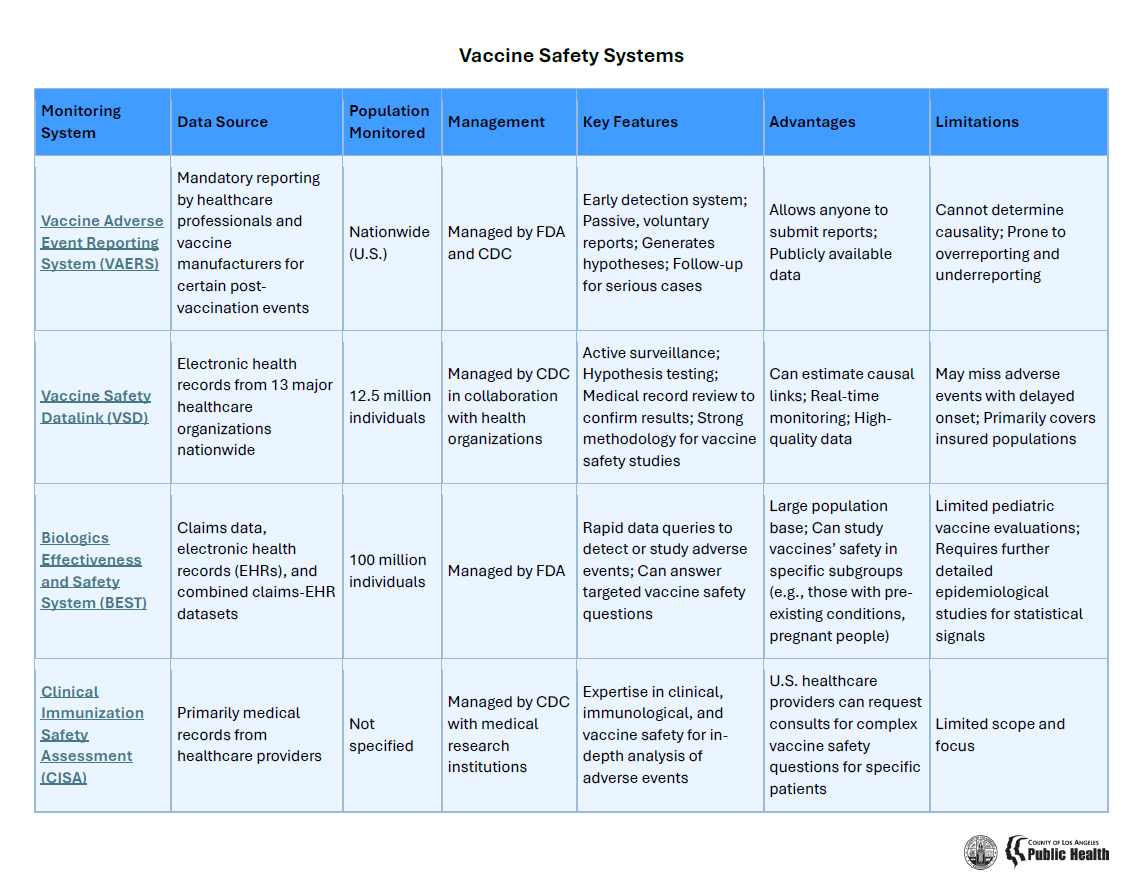
Several systems actively monitor vaccine safety after the vaccine is approved for use. When discussing vaccines with vaccine hesitant patients, it can be helpful to mention these safety monitoring systems to address safety concerns.
Click here to view a list of vaccine safety systems or click the image.
Resources & Support
- Vaccine hesitancy and health care providers: Using the preferred cognitive styles and decision- making model and empathy tool to make progress (NIH)
- Explores factors influencing provider vaccine hesitancy and proposing the use of evidence-based tools that emphasize individualized approaches and health literacy.
- Childhood Immunization Discussion Guides (AAP)
- Understanding and Combating Misinformation: An Evolutionary Perspective (JMIR Infodemiology)
- Vaccine Confident Campaign (American College of Preventive Medicine)
- Create a dialog with preventive medicine experts about why you can be confident in the science behind vaccines.
- Vaccine Confidence Training and Toolkit (The American College of Obstetrics and Gynecologists)
- Gives providers tools and strategies to communicate about vaccines, build trust, and address vaccine hesitancy in patients.
Immunization Schedules (CDPH recommends immunization of children, adolescents, and adults in accordance with the AAP & AAFP):
Contact & Support
- Vaccine Preventable Disease Control Program: LACIPInfo@ph.lacounty.gov.
- Subscribe to VPDCP Newsletters:
- Weekly Digest Newsletter: email vaccinereq@ph.lacounty.gov
- Quarterly Vaccine Provider Newsletter
- Vaccine Information Hub for Providers (LAC DPH)
