Beaches
The Recreational Waters Program routinely collects ocean
water samples every Monday at 40 sampling sites
extending from the Ventura/Los Angeles County border to
south of the Redondo Beach pier. In addition, five
samples are collected at Avalon Beach on Catalina from
April through October. Samples are collected in the surf
zone and analyzed by the Department of Public Health
laboratory for total coliform, E. coli and enterococcus
bacteria.
Water contact in ocean water with elevated bacteria
levels may cause illness. Beach users are cautioned to
avoid water contact near flowing creeks and storm
drains.
Sign up for beach water alerts
Beach Advisory & Closure Hotline:
1-800-525-5662
What We Do
The Recreational Waters Program routinely collects ocean
water samples in the surf zone and is analyzed by the
Department of Public Health laboratory for total
coliform, E. coli and enterococcus bacteria.
We monitor and review
Ocean Water Monitoring Results
from the Los Angeles City, Bureau of Sanitation,
Hyperion treatment plant and the Los Angeles County
Sanitation District. The Hyperion treatment plant's
laboratory makes available to our program, daily
bacteriological data for 10 shore stations and weekly
bacteriological data for 34 shore stations. The Los
Angeles County Sanitation District makes available,
weekly bacteriological data for 8 shore stations. Water
is analyzed for total coliform, fecal coliform, and
enterococcus bacteria.
-
Beaches are posted with warning signs when bacteria
levels exceed State ocean water quality standards.
Beaches remain posted with warning signs until tests
indicate that bacteria levels meet State standards.
-
Beaches are closed when a suspected or real sewage
discharge to ocean waters occurs or elevated
bacteriological levels can be linked to a known
sewage discharge. Samples are collected from the
affected areas and the beaches are kept closed until
sampling data indicates that bacteria levels meet
State standards.
-
A rain advisory is issued anytime there is
significant rainfall that may cause bacterial levels
to exceed State standards in ocean waters. The
advisory stays in effect for 72 hours after rainfall
has ended.
-
We investigate complaints of beach sanitation,
illegal discharges, sewage spills and areas of high
chronic bacteria levels.
Information and Documents
Sewage Discharge
General Information
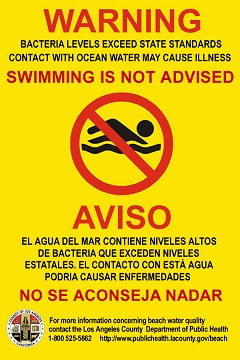
What Do The Beach Signs Mean?
Warning Sign with Yellow Background
The warning sign with the yellow background is
used in areas of the beach where testing
indicates that bacteria levels exceed State
bacteriological standards. Contact with ocean
water in these areas may cause individuals to
become ill. Avoid water contact where signs are
posted and areas between posted signs. Signs are
normally posted on the sand at 50 and 100 yards
north and south of the affected beach sample
site(s).
Also used for all beaches during an ocean water
quality rain advisory.
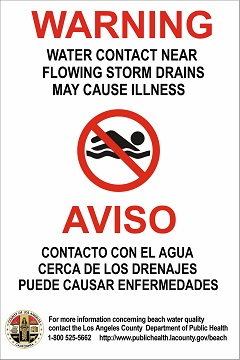
Warning Sign with White Background
The warning sign with the white background is
used at or near storm drain outlets and creeks
that may spill into the ocean. If a storm drain
runs underground and terminates directly into
the ocean, signs will be posted 50 and 100 yards
on either side of the termination point along
the shoreline. Contact with ocean water in these
areas may cause individuals to become ill. Avoid
water contact where signs are posted and areas
between posted signs.
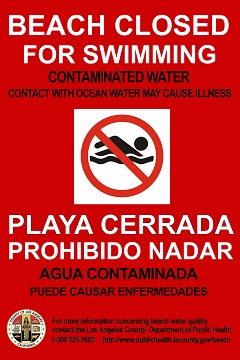
Beach Closed Sign with Red Background
The beach closed sign with the red background is
used when there is a sewage spill or chemical
discharge affecting ocean waters. It means the
water is contaminated and individuals should
avoid any and all water contact. Signs will be
posted at 50 and 100 yards on either side of the
affected recreational water area. Avoid water
contact where signs are posted and areas between
posted signs.
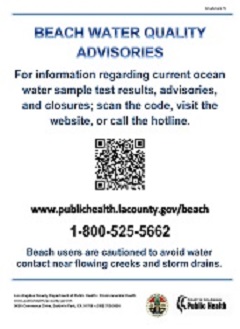
Beach Water Quality Advisories Sign
The beach water quality advisories sign is used
to provide links to beach water quality
information via a QR code and website link to
the Beach Advisories page of the Environmental
Health website, and by providing the Beach Water
Quality Hotline phone number. Signs may be
posted at beach entrances and at the beach.
Report a Problem
To report after hours beach emergencies, contact the Los
Angeles County Operator at
(213) 974-1234.
If you observe code violations or would like to file a
complaint, you may report this issue by calling the
Recreational Waters Program
(626) 430-5360
or
File a Complaint Online.